Palm olein, the liquid fraction of palm oil from the fruit is often confused with palm kernel oil from the pit. Both contain saturated fatty acids, about 50% and 80%, respectively. In contrast, palm olein is the healthier choice, whereas palm kernel oil is highly saturated. Many people assume that since red palm oil contains saturated fatty acids, it is artery clogging. Not so.
A large and growing body of published research (1-17) have established that red palm oil does not have the same artery-clogging effect as other saturated fats. This is due to Palmitic acid, the major saturated fatty acid (45%) in palm oil, and stearic acid (5%). Palmitic acid is not only neutral, but has been found to increase beneficial HDL-cholesterol levels significantly.
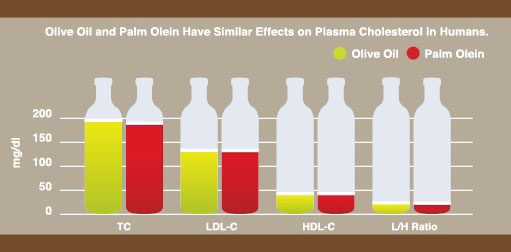
Numerous peer reviewed studies have shown that palm oil behaves more like a mono-unsaturated oil than a saturated oil. The unsaturated portion of palm oil is a mono-unsaturated oil (40%), just |
|
like olive oil. But unlike olive oil, palm oil’s natural resistance to oxidation makes it a healthier and safer oil for cooking or deep frying. Since red palm oil is 50% saturated, it does not need to undergo hydrogenation, a process that produces trans fatty acids.
The fatty acid that gives olive oil its beneficial effects is called oleic acid. Seventy to eighty percent of the fatty acids in olive oil are oleic acid compared to 45 percent in red palm oil. Despite the lower content of oleic acid in palm oil, the ability of olive oil and palm oil to regulate cholesterol levels in the body is identical.
In the US, the Food Drug Administration has approved palm-oil products sold under the Smart Balance brand (containing up to 50% palm oil and 50% local oils) to make the following claims under the patented label, To help increase HDL (‘Good’ Cholesterol) and improve the Cholesterol Ratio (HDL/LDL). |
References:
1. Asia Pac. J. Clin. Nutr. 2002; 11(suppl).
2. Journalof the American College of Nutrition,
1992;11(4), 383-390.
3. J Nutr. 1997 Mar;127(3):509S-513S.
4. Asia Pac J Clin Nutr. 2002;11 Suppl 7:S424-32.
5. Asia Pac J Clin Nutr. 2002;11 Suppl 7:S416-23.
6. Arch Latinoam Nutr. 2002 Jun;52(2):145-50.
7. Food Nutr Bull. 2002 Mar;23(1):11-22. Review.
8. J Nutr. 2001 Aug;131(8):2115-20. |
|
9. Int J Food Sci Nutr. 2000;51 Suppl:S21-30.
10. Med J Malaysia. 1999 Sep;54(3):408-27; quiz 428.
11. Lipids. 2000 Jun;35(6):621-5.
12. Lipids. 1998 Sep;33(9):879-87.
13. Ann Nutr Metab. 1997;41(3):137-48.
14. Arterioscler Thromb. 1994 Apr;14(4):567-75
15. Am J Clin Nutr. 1995 May;61(5):1043-51.
16. Br J Nutr. 1992 Nov;68(3):677-92.
17. Am J Clin Nutr. 1992 Jan;55(1):51-62.
|